Respect is innate to the Hungarian language. When I was a child, I was taught the polite form of address for people who were older than I (at the time it seemed like they all were). The expression literally means “I kiss your hand.” For me, the term was gender-neutral. I used it to address both older men and women. Nowadays, it is only used by men or youths in addressing women, usually older women. So you can imagine how I felt at Ferihegy Airport on our first day in Hungary. I approached some customs agents to ask them where we were supposed to go with our luggage and they greeted me with that expression. I turned around to see if they were talking to someone else. But no, it was I… I have to admit, it blew my mind, not because I mind (that much) getting older, but because this is a term that I used as a child and now it applied to ME. I have just had several glasses of very good Villanyi wine, so I hope that I am expressing myself clearly. I guess I forgot that I aged and they, very courteously, reminded me of that inescapable fact.
So. when I got to the grocery store and ask the young man to weigh my vegetables, he usually greets me with that term of respect, as does the porta (who is NOT that much younger than I) when I go to pick up the key for my classroom. What was a little tougher to understand was when a man who is decades older than I used that term repeatedly during the course of our conversation. So, I find myself nonplussed.
The Hungarian language with its formal and informal voices, its rules about proper address and respect, validates traditional ideas about gender. A State Department colleague remarked that feminism is viewed with suspicion, partly because the Communists decided they were feminists and made it official government policy, but partly because it goes against the social order that the language, by its very structure, reflects.
Yesterday, in my Seminar on the US and the Cold War, we discussed a reading by Elaine Tyler May in which she argues that after World War II, Americans were beset by anxieties: concerns about sexual chaos that seemed to have been unleased during the war, fears about communism and atomic destruction, and anxiety about gender roles in the aftermath of millions of American women entering the wartime workforce, sometimes doing “men’s work.” At any rate, May makes a pretty compelling argument that many of the baby boomers agreed to a kind of reproductive consensus and a form of domestic containment that mirrored America’s foreign policy of containment vis-a-vis the Soviet and communist worlds.
I showed the students lots of photos from the 1950s, including pictures of young families moving into the new “suburbs,” men waiting to catch the commuter train to go to work, and American women at Tupperware parties. If you’re interested, click here for some similar photos. All the photos in the PowerPoint represented white, middle-class American ideals of the post-war world. The students were very much struck by these photos, commenting that this American dream of individual home ownership was more and more difficult for Hungarians today.
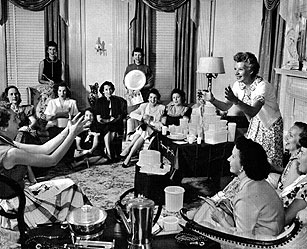
One thoughtful young woman asked a question about this idealized world and whether these American women had made the right choices…this was within the context of the difficult times that Hungarian women are experiencing trying balance work and family life. What she was really asking me about was about feminism and what it signified for women. I started to talk about Simone de Beauvoir and then realized, this was going off in a tangent from which it would be very difficult to get back to course themes. So I said, perhaps we can get together over coffee and talk about Simone de B. Several women raised their hands and said they wanted to come. I asked them if they were legal, and they all nodded eagerly. So, we will go to a local borozo (wine shop) and share some wine and talk about feminism and their concerns as Hungarian women who want to make the choices that are right for them… the wine and coffee will be on me.
I truly believe that a lot of it goes back to the values inherent in the widespread custom of addressing women by kezét csókolom. But we’ll see.
Thanks for tuning in and best regards,
Marcsi
Leave a Reply